Bankroll management is how much of your betting capital you risk on each wager. Get sizing wrong and a real edge still blows up — or compounds too slowly to matter.
The Kelly Criterion is the proportional staking rule that maximises long-run growth rate when you know the edge and odds, and you size one bet at a time against the current bankroll. Most serious bettors use a fraction of Kelly, not full Kelly.
Edge and price first: Value betting, Expected value (EV). Odds formats: Sports betting odds explained.
As an alternative to reading this article, you can watch this video:
Flat stake vs proportional stake
Two common approaches:
- Flat stake — same cash amount every bet (or the same amount for bets that share odds/edge). Simple. Hard to calibrate: too large and ruin risk rises; too small and growth crawls even with edge.
- Proportional stake — a percentage of current bankroll. Stakes rise after winning runs and fall after losing runs. Kelly is the growth-optimal rule inside that family (under its assumptions).
Neither turns a −EV process into a +EV one. Sizing only decides how variance and growth interact given an edge.
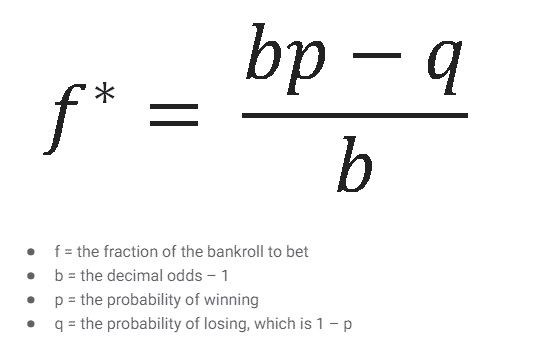
The Kelly Criterion formula
For a binary bet at decimal odds G, with your estimated win probability P:
edge = (G × P) − 1
f* = edge / (G − 1)
Equivalently:
f* = P − (1 − P) / (G − 1)
f* is the fraction of current bankroll to stake under full Kelly. G − 1 is the net fractional odds (profit per 1 unit staked if you win).
Assumptions that matter in practice:
Pis the true win probability (or an unbiased estimate). WrongP→ wrongf*.- One bet at a time, bankroll updated before the next stake.
- Independent (or treated as independent) outcomes.
- You can actually get the stake on at
G(limits and liquidity bite).
Worked coin-flip example
Fair coin, true P = 0.5. Fair decimal odds are 2.00. You are offered G = 2.10.
edge = (2.10 × 0.5) − 1 = 0.05 = 5%
f* = 0.05 / 1.10 ≈ 0.04545 = 4.545%
So full Kelly says stake ~4.545% of current bankroll. Illustrative odds only — not a tip.
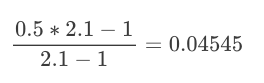
Percentage of bankroll to stake under full Kelly for this example.
Worked sports-price example
Bankroll £1,000. You estimate P = 0.52. Book offers G = 2.10.
edge = (2.10 × 0.52) − 1 = 0.092 = 9.2%
f* = 0.092 / 1.10 ≈ 0.08364 = 8.364%
| Plan | Fraction of bankroll | Stake on £1,000 |
|---|---|---|
| Full Kelly | 8.364% | £83.64 |
| Half Kelly | 4.182% | £41.82 |
| ~30% Kelly | 2.509% | £25.09 |
Same edge, three risk levels. Half Kelly cuts path variance hard; average growth falls only a little versus full Kelly (see simulation below).
If your P is wrong — say you use 0.55 when the true rate is 0.50 at the same 2.10 — your computed full Kelly is f* ≈ 14.09% (£140.91) while true full Kelly is only 4.545%. That is overstaking past the real maximiser: long-run growth falls and drawdowns jump. Kelly does not forgive a bad probability source.
Order does not matter for two sequential bets
Start with $100, same coin-flip edge (f* ≈ 0.04545), win one and lose one, updating bankroll between bets:
- Stake
0.04545 × 100 = $4.545and lose → bankroll$95.455. - Stake
0.04545 × 95.455 ≈ $4.338and win → profit$4.338 × 1.10 ≈ $4.772→ bankroll$100.227.
Win first then lose second: same end bankroll $100.227. For sequential full-Kelly bets on the same edge, order does not change the end bankroll after a fixed win/loss set.
Results distribution with different Kelly fractions
The two-bet walk-through assumes you know the previous result before the next stake. In practice you often have many bets open at once (a handful to dozens). That changes path risk.
If you size each of 10 open bets as if it were alone on the full bankroll, total risk exceeds a single sequential Kelly bet. If you update bankroll after each placement while results are still open, early stakes are larger than later ones — so you can lose the big tickets and win the small ones (or the reverse).
Take 20 open bets, each at odds 2.10 with 5% edge (true win rate 50%). Fix exactly 10 wins and 10 losses — every path is “fair” on hit rate; only order changes. There are C(20,10) = 184,756 such paths.
Chart: x-axis = ending bankroll relative to start; y-axis = number of paths. Stakes follow Kelly on the running bankroll (4.545% per bet). Blue = 100% Kelly, orange = 50% Kelly, green = 30% Kelly.
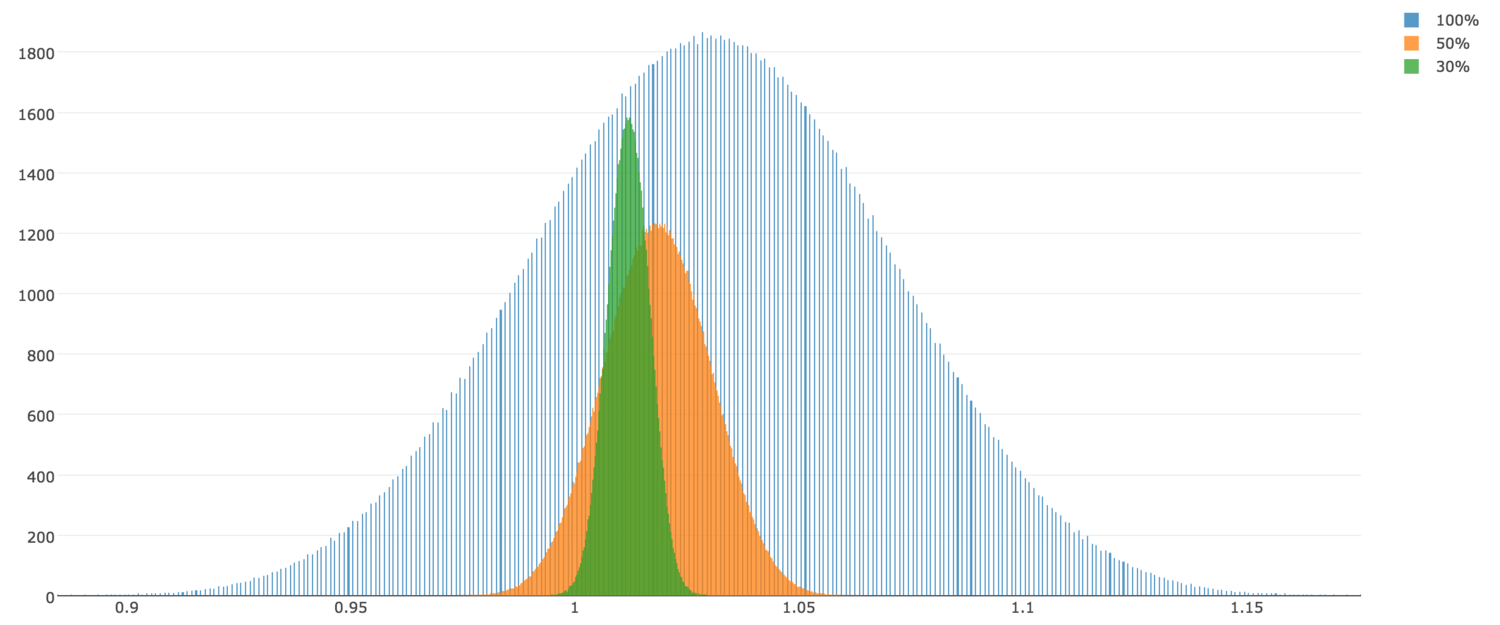
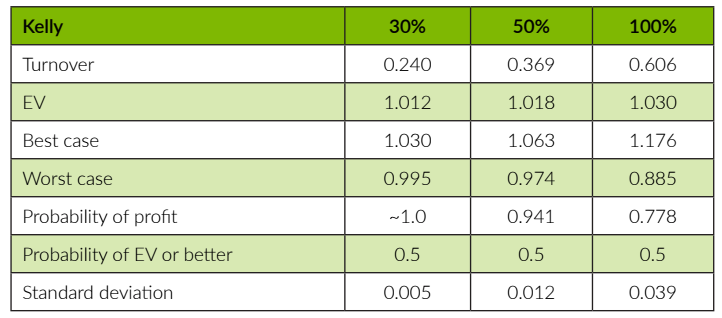
Full Kelly (blue) has the highest average ending bankroll (~1.03×, i.e. ~+3%) but the widest spread — roughly 0.88× to 1.18× starting bankroll on these paths. Half and 30% Kelly tighten the distribution: probability of finishing ahead rises a lot; average growth falls only a little.
| 30% Kelly | 50% Kelly | 100% Kelly | |
|---|---|---|---|
| Turnover (total risk / start BR) | 0.240 | 0.369 | 0.606 |
| Average ending BR (EV) | 1.012 | 1.018 | 1.030 |
| Best case | 1.030 | 1.063 | 1.176 |
| Worst case | 0.995 | 0.974 | 0.885 |
| Prob. of profit | ~1.0 | 0.941 | 0.778 |
| Prob. of EV or better | 0.5 | 0.5 | 0.5 |
| Std. deviation | 0.005 | 0.012 | 0.039 |
So: 100% Kelly risks about 61% of bankroll in turnover to average ~1.03×. 50% Kelly risks 37% for average **1.02×. 30% Kelly risks ~24%** for average ~1.01×.
Same sample-size intuition: Law of large numbers in sports betting.
Stats for three Kelly settings
Why most bettors use fractional Kelly
Full Kelly maximises growth rate under its assumptions. Most serious bettors still use a fraction (commonly half or ~quarter–third). Practical reasons:
- Edge is estimated, and prices move. A bet placed hours before off can swing for or against you. Half Kelly leaves room if
Pwas slightly overstated; if the edge improves, you can still add. Closing-line checks help keep that honest — Closing line value (CLV). - Full Kelly is volatile. Long drawdowns are common even with true edge (variance in sports betting, reducing variance).
- Many bets open at once. Treating each as a lone full-Kelly bet overstates total risk. Fractional Kelly (or an explicit open-bet budget) is the usual fix.
Smaller stakes also tend to draw less heat from soft books. See how bookmakers profile winning players and how to avoid getting limited.
Do not bet more than full Kelly. Overstaking past f* reduces long-run growth; full Kelly is already the maximiser under the model.
Spreading bankroll across bookmakers
In practice, spread funds across as many usable books as you can, with a few constraints:
- Max deposit offers when they matter. Bonus terms and sizes change by book and market — wait until you can clear the ones worth clearing before parking size there.
- Weight toward volume. Put a larger share where you actually get filled (higher trade count), a smaller share on low-volume books, and keep a reserve in bank/e-wallet until you know where turnover lands — and so one limited book does not stop you. Idle cash caps turnover (and EV).
There is no single “correct” Kelly fraction. It depends on risk tolerance, how sharp your P estimates are, and how many correlated bets you run open at once. Full Kelly, half Kelly, and ~30% Kelly are the usual reference points.
When you want a workflow that surfaces +EV prices against a reference line — with stake sizing left to your bankroll rules — start with Trademate Sports. No invented ROI claims; the Kelly maths above is the staking framework.
FAQ
What is the Kelly Criterion in sports betting?
A proportional staking formula that maximises long-run bankroll growth for a known edge and decimal odds. For a binary bet: f* = edge / (odds − 1), where edge = (odds × P) − 1 and P is your win probability.
Should I use full Kelly or fractional Kelly?
Most serious bettors use a fraction (often half or ~30%). Full Kelly maximises growth under ideal assumptions but is volatile, and real P is estimated. Fractional Kelly cuts drawdowns for a modest growth trade-off.
Is Kelly better than flat staking?
Different tools. Flat staking is simple and keeps stake size stable in cash terms. Kelly (and fractional Kelly) scales with bankroll and edge. Neither fixes a −EV process. Choose based on how reliable your edge estimates are and how much path variance you can stomach.
What if my probability estimate is wrong?
Kelly sizes from P. Overstated P → oversized stakes → lower long-run growth and deeper drawdowns. That is why fractional Kelly and market checks like CLV matter alongside EV.
Can I Kelly-size many correlated bets at once?
Not as independent full-Kelly tickets on the same bankroll. Correlation and overlapping exposure inflate total risk. Use a smaller Kelly fraction, an open-bet cap, or treat related positions as one risk unit.
Does smaller staking help avoid bookmaker limits?
It can reduce heat versus slamming max stakes into every soft price, but it does not make you invisible. Sustained +CLV / +EV volume still gets limited. Practical notes: How to avoid getting limited.